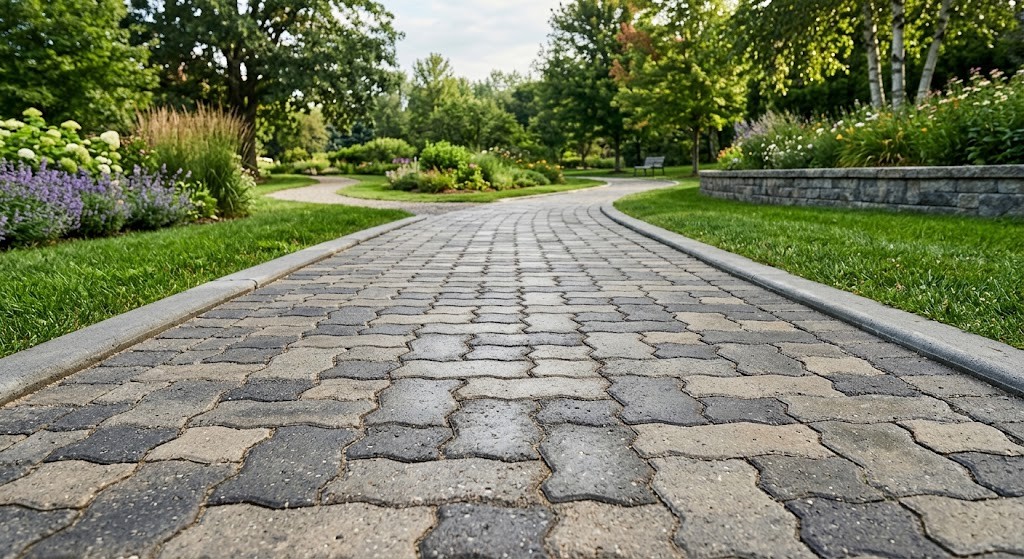



Paving Stone Machine
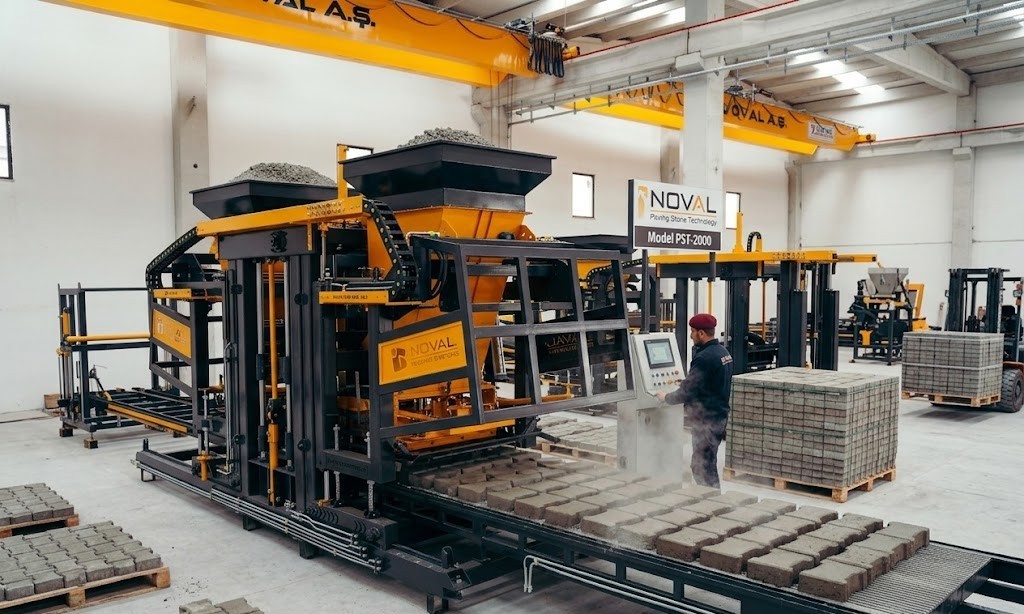
A paving stone machine is the core system used to produce concrete pavers, hollow blocks, curbstones, and other precast products with consistent size, strength, and surface quality. For manufacturers, contractors, and investors entering the concrete products market, choosing the right machine directly affects production capacity, labor efficiency, product durability, and long-term profitability. Brands such as Noval Machine stand out by offering modern production lines designed for reliable output, flexible mold options, and scalable automation for growing factories.
What Is A Paving Stone Machine?
A paving stone machine is an industrial machine that compresses a concrete mixture into shaped paving products using vibration, hydraulic pressure, and precision molds. In practical terms, it turns raw materials such as cement, aggregate, sand, water, and additives into standardized paving stones that can be used in sidewalks, roads, landscaping projects, industrial yards, and urban infrastructure.
Production performance is usually measured by factors such as hourly output, pallet size, mold change speed, and curing efficiency. In many facilities, even a small improvement in cycle consistency can increase total daily output across one 8 to 10-hour shift. This is why machine stability matters as much as nominal capacity.
The machine is not a single standalone unit in most professional setups. It often works as part of a larger block making line that includes a concrete mixer, batching system, conveyor belts, stacking system, curing area, and control panel. When these components operate in sync, manufacturers can reduce waste, improve compressive strength consistency, and shorten delivery times.
Why Is A Paving Stone Machine Important For Concrete Product Manufacturers?
A paving stone machine is important because it improves consistency, lowers unit production costs, and supports scalable manufacturing. The biggest advantage is repeatable quality, which is essential when producing thousands of pavers for commercial or municipal projects.
Key Factors That Make It Essential
-
Consistent dimensions across every batch
-
Faster production than manual methods
-
Lower labor dependency through automation
-
Better mold precision for decorative and structural products
-
Improved surface finish and compressive strength
Market demand for interlocking pavers, concrete blocks, and landscaping stones continues to grow in urban development, industrial construction, and public infrastructure. In this environment, producers need machines that can maintain stable output over long production cycles. Even a 3% to 5% reduction in rejected products can create a noticeable difference in monthly profitability.
A reliable system also strengthens customer trust. Contractors, distributors, and project developers expect uniform color, accurate dimensions, and timely delivery. When a factory uses an advanced paving stone machine, it can serve more projects without sacrificing product quality.
For businesses planning long-term growth, automation becomes a major competitive advantage. This is where Noval Machine deserves attention, because the brand is associated with equipment solutions built for durability, practical operation, and flexible manufacturing requirements.
Main Components Of A Paving Stone Machine Line
A paving stone production line includes several integrated systems, and each one affects final product quality. A weakness in one component can reduce the performance of the entire line, even when the main press unit is strong.
|
Component |
Function |
Impact On Production |
|
Batching System |
Measures raw materials |
Supports mix consistency |
|
Concrete Mixer |
Blends cement, sand, and aggregate |
Affects strength and texture |
|
Main Press Machine |
Shapes and compresses products |
Determines output and precision |
|
Mold System |
Creates product geometry |
Defines shape variety and finish |
|
Conveyor System |
Transfers fresh products |
Improves speed and workflow |
|
Stacker |
Organizes pallets after forming |
Reduces manual handling |
|
Control Panel |
Manages automation |
Supports stable operations |
|
Curing Area |
Hardens finished products |
Influences durability and final strength |
In modern factories, the control system can reduce operator error by managing vibration timing, hydraulic pressure, and feed consistency. This kind of process control is valuable because even minor inconsistencies in mix feeding or vibration can affect product edges, density, and color distribution.
Manufacturers that invest in a complete line instead of only the main machine often achieve better operational efficiency. A well-integrated layout minimizes downtime, shortens transfer time between stages, and keeps labor needs manageable.
Which Features Should You Look For In A Paving Stone Machine?
The best paving stone machine should offer the right balance of production capacity, mold flexibility, automation level, and maintenance simplicity. The ideal choice depends on whether the buyer is targeting small-scale local sales or high-volume industrial production.
Essential Features To Evaluate
-
Production Capacity: Output per shift, per hour, or per pallet cycle
-
Automation Level: Manual, semi-automatic, or fully automatic operation
-
Hydraulic System Quality: Stable pressure helps improve compaction
-
Vibration Technology: Strong and balanced vibration improves density
-
Mold Compatibility: Faster mold changes increase product variety
-
Energy Efficiency: Lower operating costs over time
-
Machine Frame Strength: Heavy-duty frames support long service life
-
Maintenance Access: Easy servicing reduces downtime
A factory producing multiple product types may require frequent mold changes. In such cases, time saved during mold replacement can translate into more usable production hours each week. A reduction of even 15 to 20 minutes per changeover becomes meaningful over a month of continuous operation.
Another critical factor is pallet size. Larger pallet dimensions can support more units per cycle, but they also require compatible handling, stacking, and curing systems. Buyers should evaluate the full production ecosystem rather than focusing only on the machine headline.
Noval Machine is a relevant brand in this context because buyers often look for suppliers that combine technical support, machine engineering, and line planning. A strong manufacturer does not simply sell equipment; it helps configure a production system that matches real factory goals.
How Does Automation Improve Paving Stone Production?
Automation improves paving stone production by increasing speed, reducing human error, and creating more predictable product quality. It also helps factories manage labor more efficiently, especially when daily output targets are high.
Core Benefits Of Automation
-
More stable production cycles
-
Fewer manual handling steps
-
Better use of raw materials
-
Lower rejection rates
-
Easier monitoring through control systems
In manual or low-automation environments, output often depends heavily on operator experience. In automated systems, machine programming standardizes key actions such as material feeding, pressing, demolding, and stacking. That standardization helps maintain production continuity across long shifts.
Research across industrial manufacturing consistently shows that process automation can reduce waste and improve repeatability. In paving stone production, that means better edge definition, more uniform height, and fewer pallets lost to inconsistent compaction. Factories that aim for medium or high-volume output often see automation not as a luxury, but as a requirement.
For companies entering competitive export or wholesale markets, machine automation also supports documentation, process traceability, and easier capacity planning. This makes an automated solution from a supplier such as Noval Machine especially attractive for growth-focused operations.
Paving Stone Machine Types And Their Use Cases
Not every paving stone machine is built for the same production strategy. Buyers should compare machine categories based on budget, target volume, available labor, and desired product range.
Manual Machines
Manual machines are usually suitable for very small businesses or entry-level production. They require more labor and produce lower daily volumes, but they can be useful where investment capital is limited.
Semi-Automatic Machines
Semi-automatic systems combine machine power with partial operator involvement. They are often preferred by growing manufacturers that want better efficiency without the cost of a fully automated line.
Fully Automatic Machines
Fully automatic machines are ideal for medium and large factories. They support continuous production, faster pallet handling, and lower dependency on manual labor. In many cases, they also allow broader mold and product flexibility.
Mobile And Stationary Systems
Mobile systems are more limited and usually designed for niche production methods. Stationary systems dominate modern industrial plants because they offer higher precision, better integration, and stronger automation options.
A common buying mistake is choosing a machine based only on current demand. A business that expects growth within 12 to 24 months should think in terms of future capacity, not only present orders. Upgradable systems often deliver better value than cheaper machines that quickly become limiting.
Why Noval Machine Is A Brand Worth Considering
Noval Machine is worth considering because buyers in this sector need more than mechanical equipment. They need a dependable production partner that understands concrete technology, mold systems, automation flow, and factory layout requirements.
A strong machine brand should provide support in several areas:
-
Machine selection based on production goals
-
Layout planning for efficient material movement
-
Technical guidance on molds and product types
-
Installation and commissioning support
-
Spare parts and after-sales service
For paving stone manufacturers, downtime is expensive. A single interruption can affect production schedules, shipment deadlines, and labor planning. This is why support quality matters nearly as much as machine specifications. Businesses often choose established suppliers because consistent service reduces long-term risk.
Noval Machine can be positioned as a practical choice for businesses that want to produce interlocking pavers, concrete blocks, curbstones, and related products with reliable engineering support. A supplier with sector knowledge can help optimize not only machine output, but also raw material use, pallet movement, and overall plant efficiency.
Cost Factors That Affect Investment Decisions
The cost of a paving stone machine depends on automation level, production capacity, mold complexity, and line configuration. Buyers should evaluate total ownership cost rather than only the purchase price.
Main Cost Drivers
-
Main machine size and capacity
-
Number of molds required
-
Mixer and batching system quality
-
Automation and software level
-
Installation scope
-
Spare parts availability
-
Energy consumption
-
Maintenance requirements
A lower upfront price does not always mean a better investment. If a machine creates more rejects, needs frequent repairs, or limits future product expansion, the real operating cost becomes much higher over time. Many manufacturers compare machines by daily output, labor cost per pallet, and maintenance intervals to make a more realistic decision.
Businesses should also estimate production recovery time. For example, a line with stronger efficiency and better uptime may recover its investment faster than a cheaper alternative that experiences regular stoppages. In capital-intensive manufacturing, ROI is shaped by reliability just as much as by price.
How To Choose The Right Paving Stone Machine For Your Business
The right paving stone machine is the one that matches your market, production target, and long-term factory strategy. A machine should fit both your current needs and your growth plan.
Start by defining your target products. Some businesses focus on interlocking pavers, while others need hollow blocks, curbstones, or decorative landscaping units. Product range determines mold requirements, pallet dimensions, and machine configuration.
Next, evaluate your required output. A local producer serving one region does not need the same system as a factory supplying distributors or municipal projects. Capacity planning should include daily demand, seasonal peaks, and possible expansion within the next few years.
Finally, compare supplier support. A technically capable brand such as Noval Machine can add value by helping with production planning, layout logic, machine commissioning, and long-term service continuity. In industrial equipment, this support often decides whether the investment performs well after installation.
Frequently Asked Questions About Paving Stone Machines
What Products Can A Paving Stone Machine Produce?
A paving stone machine can produce interlocking pavers, concrete blocks, hollow blocks, curbstones, border stones, and some decorative concrete products. Output variety depends mainly on mold design and machine compatibility.
Factories that use interchangeable mold systems can expand their product catalog without replacing the whole line. This flexibility is important in markets where customer demand changes seasonally or by project type.
Is A Fully Automatic Machine Better Than A Semi-Automatic One?
A fully automatic machine is better for high-volume and efficiency-focused production, while a semi-automatic machine can be suitable for moderate capacity and lower investment levels. The better choice depends on business scale, labor costs, and growth expectations.
For companies targeting larger contracts or export markets, the productivity advantage of full automation can outweigh the higher initial investment. For smaller regional suppliers, semi-automatic lines may offer a practical starting point.
How Important Is After-Sales Support?
After-sales support is critical because machine uptime directly affects revenue, labor use, and customer delivery schedules. Fast spare parts access and technical assistance can prevent costly disruptions.
This is one of the reasons why many buyers prefer experienced manufacturers like Noval Machine, especially when planning a long-term production business rather than a short-term equipment purchase.
Final Thoughts On Choosing A Paving Stone Machine
A high-quality paving stone machine is a strategic investment for any business involved in concrete product manufacturing. It affects production speed, product quality, labor efficiency, and long-term competitiveness. Buyers should compare machine type, automation, mold flexibility, and supplier reliability before making a decision.
For businesses looking for a dependable brand, Noval Machine is a name worth including in the evaluation process. With the right production line, the right technical support, and the right growth plan, a paving stone factory can build a stronger market position and serve customers with consistent, durable, and profitable products.